
The Final Frontier
The path to the stars, might be the path to our salvation.

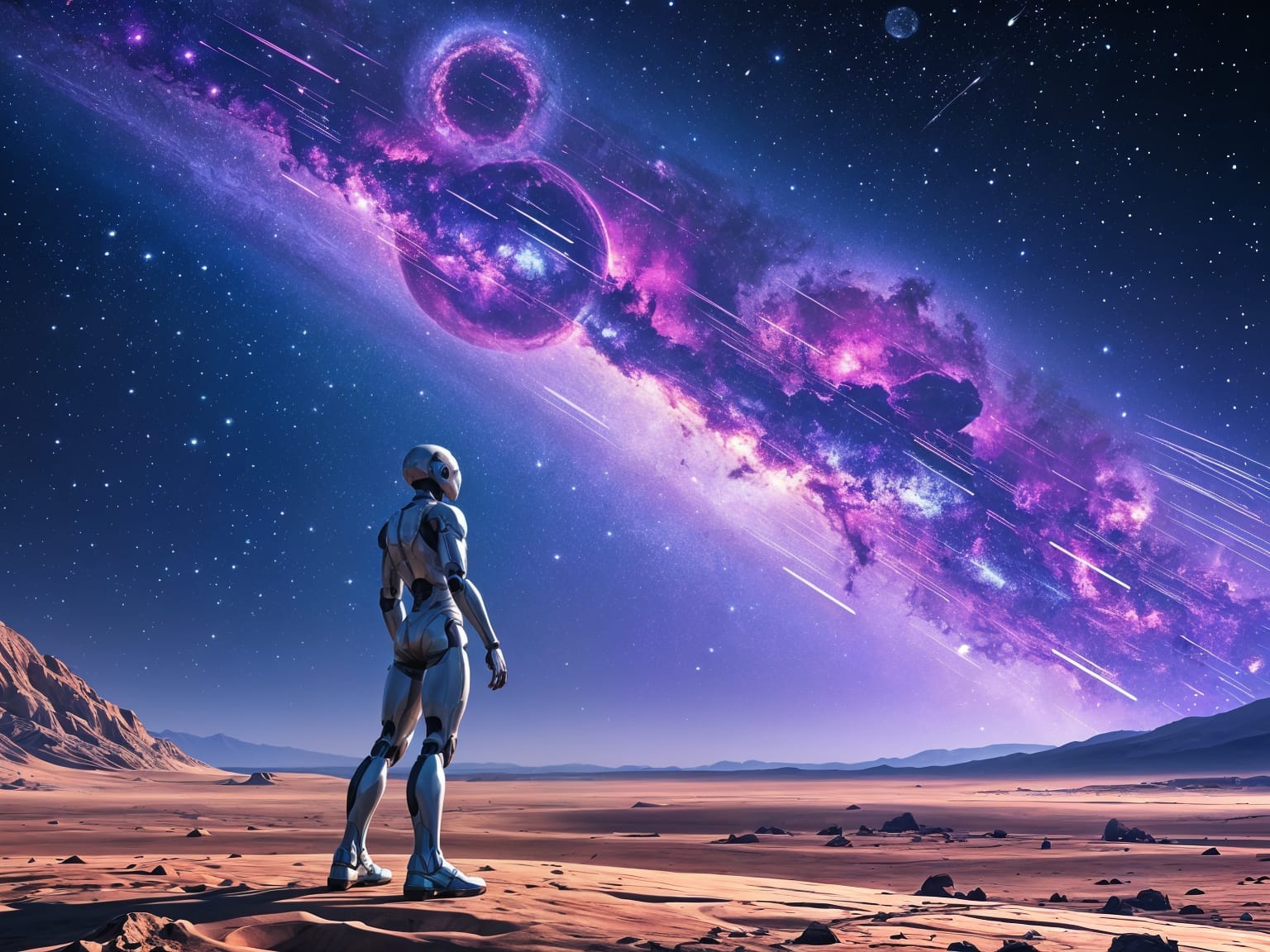
AI will eventually take us to space, whether we want to or not - and it might just save us from ourselves. No, I’m not talking about some AI-controlled spacecraft doing the exploring for us - we’ll get to that as well - I’m talking about a permanent human presence in space through the colonization of the Solar system, and possibly beyond.
But let’s take it back for a minute and see how AI fits into this.
In the last few years, we’ve witnessed the rapid evolution of AI tools and their integration into our daily lives. It’s now on every device, in every app, interlaced into the fabric of our day to day.
While AI is generally available through open-source tools for anyone to deploy and experiment with, Big AI is mostly controlled by powerful, wealthy corporations that dictate the direction of development and, consequently, how we use it. Their declared goal now is to reach a level of artificial general intelligence (AGI): an AI so advanced that it can out-perform humans in any task.
But to what end? This can’t be a purpose in itself.
The truth lies in the realm of speculation for now. It could be for the betterment of humankind. AGI might conduct research on its own, far more efficiently than humans ever could. Years of traditional research could be compressed into mere hours.
It could also be about political supremacy. Whoever controls AGI could tip the global balance of power and secure technological domination.
Or perhaps it’s simply about replacing the “fussy” and “demanding” human worker, the one who must be paid and cared for, who can only work eight hours a day, who needs time off, who quits when you need them the most, whose performance is inconsistent and makes mistakes. AI doesn’t have these problems so replacing humans with AI and robotics is an enormous incentive for big tech corporations to pour vast sums into this research.
Let’s not forget: automation has been one of the most overused words in tech for the past two decades, and AI is the king of kings when it comes to automation.
AI actually goes beyond automation: it’s about autonomy.
It’s unpacking an entire business in less than ten minutes using only AI agents instead of human workers.
It’s running factories with no lights or windows because no humans are needed inside.
It’s maintaining self-healing infrastructures that require no human administrators.
It’s building medical systems that continuously collect data from your body, predicting illness and prescribing lifestyle changes or treatments, all without ever seeing a doctor.
And the list goes on.
So it’s fair to assume that many human jobs will eventually be replaced by AI. However, this isn’t the first technological revolution we’ve experienced. Just as with the Industrial Revolution, the economy will adapt, society will adapt, and perhaps we’ll reach the utopian world that science fiction has been painting for the last fifty years or so. A world where poverty is eradicated, universal income is a fact of life, and we’re free to pursue our dream jobs, create art, make music, or do nothing at all if that’s what pleases us.
But here’s where things get tricky as human nature might get in the way of this seemingly perfect picture.
Evolution didn’t wire humans to be happy all the time. The need to be useful, the longing for the struggle, the constant testing of ourselves against the elements is ingrained in our DNA. We need that to feel alive and if we don’t get it from the environment, we usually turn against ourselves or each other. It’s why rich famous actors or musicians turn to substance abuse; it’s why old billionaires are still making moves on the market as if the rent were due. In both cases, a life of contention is not enough. When the natural struggle isn’t there, we create our own struggle - either destructive or constructive.
To avoid this fate we need to constantly evolve, expand, take on new challenges. And what greatest challenge could there be for the survival or our species if not the conquest of space? After all, dinosaurs went extinct because they didn’t have a space program.
Jokes aside, the true conquest of space - deep-space particularly - can’t happen without AI. Human beings have not evolved to live in space (yet), and there are multiple challenges to overcome before we can send people on long missions. Lack of gravity, radiation, life-support systems, psychological strain, are just a few. There are likely many other issues we haven’t even discovered yet.
So far, space exploration has been limited to human-operated or semi-autonomous craft, most of them confined to low Earth orbit. We still don’t fully understand the effects of deep-space travel has on the fragile human body and mind. To explore space, we need a level of autonomy in our spacecraft that only artificial intelligence can provide like intelligent robots capable of performing dangerous extra-vehicular tasks, both in orbit and on planetary surfaces; autonomous ships able to make real-time decisions without waiting for instructions from Earth; and, who knows, if one of these probes were to encounter extraterrestrial life, they could even serve as worthy ambassadors on our behalf.
Bottom line, if we manage to keep it under control, AI could usher in an age of infinite prosperity which in turn could act as a launching pad to space exploration and colonization. But that’s a big “if” and before we can look to the stars, we have a few worldly problems to fix down here first.
why can't we just send robots on Mars, why risk human lives? I think ASI will make us complacent, worried to lose our extended lifespan will content with monitoring things from over here...
Loved it! Impressive 👍